

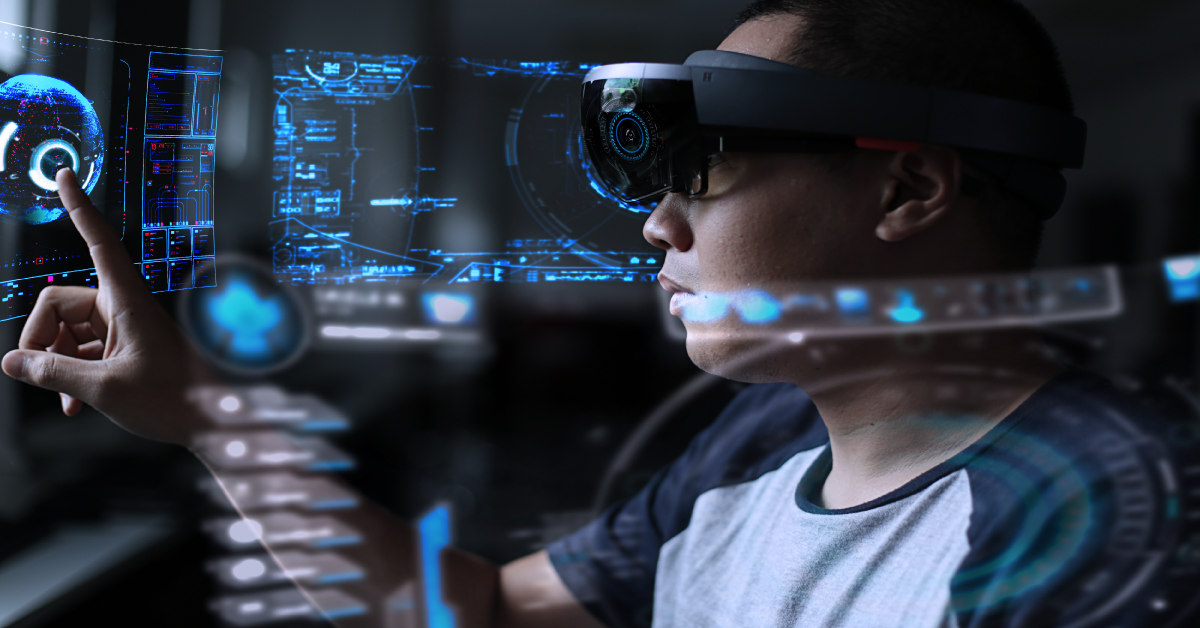
Without going into complicated definitions, augmented reality is a set of technologies that allows you to perceive interactive digital information, in real-time and in 3D in its environment. You look through your smartphone screen and see, in the middle of your living room, the sofa you haven’t bought yet.
It’s very different from virtual reality which, through a closed headset, transports you to a world that is not connected with your real environment.
In other words, augmented reality is the superimposition of reality and elements (sounds, 2D, 3D, video, etc.) calculated by a computer system in real-time. It often refers to the different methods that allow us to realistically embed virtual objects in a sequence of images.
It applies both to visual perception (superimposition of virtual images to real images) and to proprioceptive perceptions such as tactile or auditory perceptions. These applications are numerous and affect more and more fields, such as video games, education through games, virtual treasure hunts, cinema and television (post-production, virtual studios, sports broadcasts, etc.), industries (conception, design, maintenance, assembly, piloting, robotics and telerobotics, installation, impact study, etc. ) or the medical field.
On the other hand, the term “virtual reality” (or immersive multimedia or computer-simulated reality) typically refers to computer technology that simulates the physical presence of a user in an environment artificially generated by the software. Virtual reality creates an environment with which the user can interact. Virtual reality therefore artificially reproduces a sensory experience, which can include sight, touch, hearing, and smell (visual, sound, or haptic).
Again, Don’t Confuse the Two…
The augmented reality adds virtual elements in a real world environment while virtual reality created virtually a real environment or imaginary.
The purpose of virtual reality is to allow a person (or several) to live an experience of immersion in a digitally created world, which can be “imaginary, symbolic, or a simulation of certain aspects of the real world.
For the general public, it took almost ten more years to see the first uses on computers, such as the choice of packages on the US Postal site in 2008. It was also around this date that several brands such as Coca-Cola and Nike launched a few communication campaigns using the same principle (computer + webcam). The arrival of Apple’s iPhone in 2007 is another important date since it marked the possibility for users of future smartphones to use augmented reality in a “mobile” manner.
For ten years, the field has experienced ups and downs but, overall, its market share has increased, and its mobile users are growing. The first half of the 2010 decade was marked by an explosion in the number of players. These companies were often close to research laboratories and worked in both software and hardware.
Around 2015, things changed because the big digital players decided to invest in this field as well as that of virtual reality. Many pioneers have been redeemed and ecosystems have begun to take shape.
An Inventory Today
Today, for the general public, almost all augmented reality experiences go through the smartphone or tablet. The industrial sector is gradually adopting augmented reality glasses for specific uses but, for the common people, these devices are still much too expensive for too little content available.
Even the simpler eyewear devices launched by Snap in 2017 or Focal in 2018 are business failures. Microsoft has announced since 2017 that the market for its HoloLens is that of professionals. Magic Leap (two billion dollars in fundraising), which presented its “Magic Leap One” glasses as the future screen of the house in 2016, redefined its priority market in December 2019.
Sectors that work
Even though the numbers are changing very quickly, games are the most widely used category of augmented reality applications today. We all have the success of Pokémon Go in mind, but there are plenty of other titles out there that are generating revenue. For other sectors, the uses are more heterogeneous, but there are great successes in the fields of beauty (Youcam, L’Oréal, or even YouTube), furniture (Ikea Place), measuring tools, etc.
Communication and brand marketing use augmented reality to bring additional interactivity to consumers… with varying degrees of success. The Australian wine brand “19 Crimes” for example built its success on AR by using the bottle as a medium to tell the story of prisoners deported to Australia. The brand has grown from 4 to 16 million bottles sold and is attacking the US and UK markets.
Also in Australia, Domino’s Pizza has taken the gamble of making pizza ordering fun by offering an augmented reality application. The bet is a great success with an increase in the average basket and an increase in market share against its competitors.
Beyond businesses, NGOs, and “causes” have used augmented reality to illustrate their struggles. We can cite for example the project “Notable Women” launched by the former treasurer of the United States, Rosie Rios, in partnership with Google, to create an application allowing users to discover in augmented reality the history of one hundred American women on banknotes.
Can The General Public Already Experience Augmented Or Virtual Reality?
If you remember twenty years ago, there were already virtual reality headsets but it did not take off because the costs involved in buying the headset and the machine were significant.
Today, costs remain high for virtual reality with gaming headsets like the HTC or the Occulus but remain accessible. Sony makes it possible to democratize access a little more with its PS4 and its headset. In fact, with a smartphone and a plastic headset, we can already taste the vertigo of virtual reality.
And since we are talking about smartphones, augmented reality is already present in them. For the moment the user experience is still a little spoiled by the interface – the smartphone – and the satisfaction is not fully rewarding. Tomorrow, lightweight systems such as glasses or lenses will make it possible to display content and increase our experience transparently and intuitively.
These Markets Are Already Invested By Many Companies, Large or Small
Today these markets are no longer blue oceans. There is not yet market saturation but apart from releasing a virtual reality or augmented reality headset at a low price, or a lightweight headset without a battery, there is hardly any major innovation that would emerge in the market without being swallowed by the big players.
What do these markets represent today? How will they evolve?
It’s still a market that only a few people care about for high-end headsets, and it’s not really taking off. No real figures are circulating but we are now talking several hundred thousand for HTC and Occulus. One player that stands out is Sony with an offer around the PS4 which is one of the best-selling consoles around the world. In this way, the company that created the PlayStation benefits from an ecosystem that will allow it to sell content and simply offer it to its customers.
For Vive and Occulus, access is complicated because you have to be equipped with a very good machine so the starting price for a configuration that we will call ‘good enough’ is close to a thousand dollars or even more if we add high-end components.
Conclusion
Virtual worlds encompass virtual reality (VR) and augmented reality (AR). These two cousin disciplines resting on the same bases are however fundamentally different. Virtual reality immerses the user in a digital world that can be created from scratch or have been filmed beforehand. There are many applications: from video games to visiting apartments.
Augmented reality, for its part, superimposes a new layer of information on the viewer’s vision. Whether through a smartphone, a helmet, or any transparent media. It is likely that soon, as Tom Cook, the president of Apple, thinks, augmented reality will be ubiquitous and totally indispensable to modern society, as cellphones and tablets have become.
These two emerging technologies are creating a massive impact on different businesses. Virtual reality and augmented reality promise huge growth in the future. They both have multiple benefits and redefine business processes.
Virtual reality and augmented reality are wonderful examples of interactions and experiences that add a new dimension to digital devices and the real world. Alone or in combination, they undoubtedly open up real and virtual worlds.
References
- https://www.forbes.com/sites/bernardmarr/2020/01/24/the-5-biggest-virtual-and-augmented-reality-trends-in-2020-everyone-should-know-about/
- https://www.frontiersin.org/articles/10.3389/fpsyg.2018.02086/full
- https://medium.com/swlh/lets-explore-a-new-reality-the-future-of-vr-ar-9f73ed38364d